Aller au contenu principal

Cheryl L'Hirondelle: where the voice touches (((acts, utterances, transmissions for freedom)))

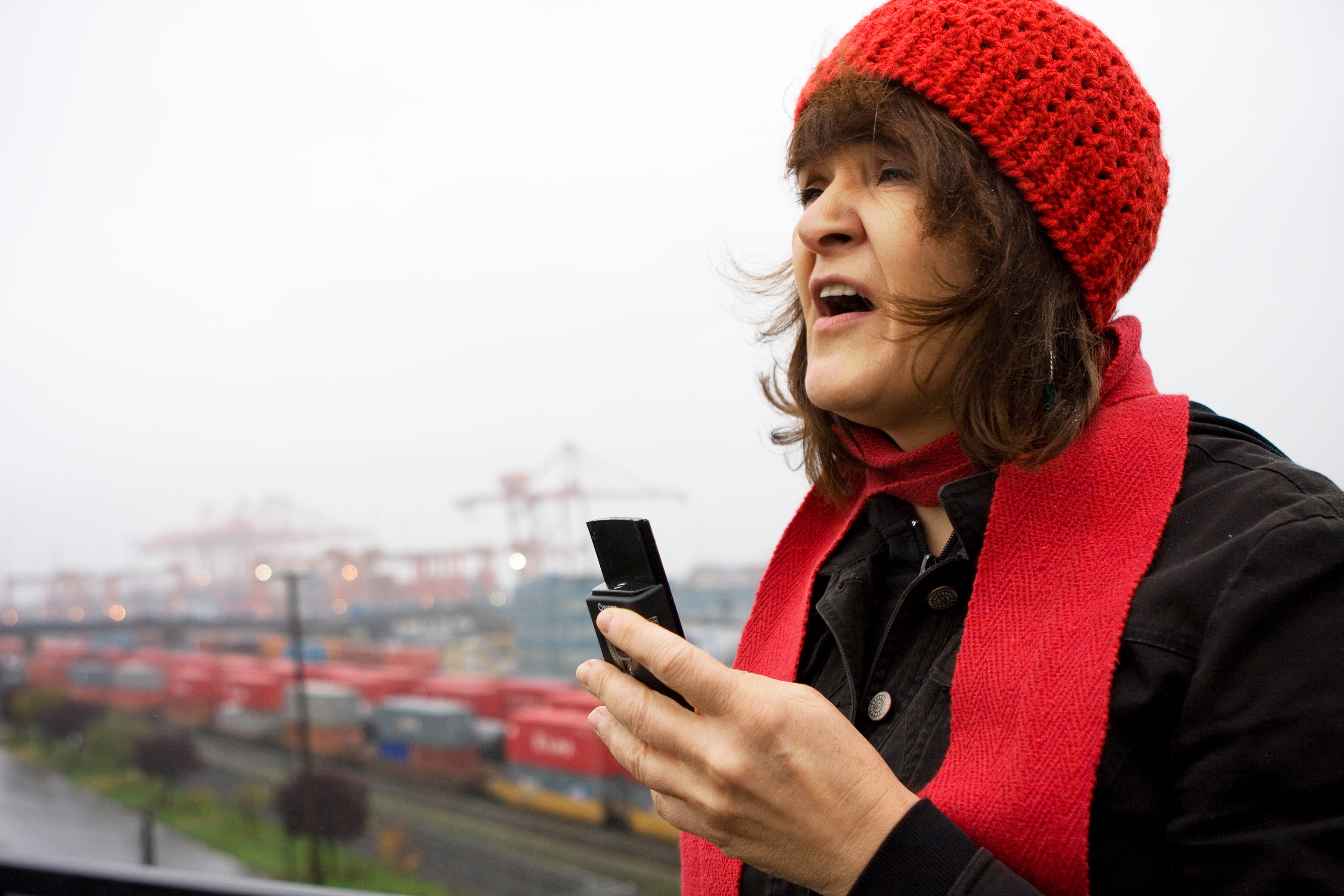
Image of person wearing red hat and scarf

Image credit: Cheryl L’Hirondelle, nikamon ohci askiy (songs because of the land), 2008. Photo: Red Works

Cheryl L'Hirondelle: where the voice touches
(((acts, utterances, transmissions for freedom)))

February 13 - June 21, 2026

Co-curated by Tarah Hogue and Jacqueline Bell

Opening Reception 
February 12, 2026, 5PM - 8PM

yāhkaskwan mīhkiwap (aka light tipi)
February 13, 2026, 6:15 PM - 7:30 PM 

Exhibition Tour 
April 1, 2026, 5:30 PM - 6 PM

Cheryl L’Hirondelle: where the voice touches (((acts, utterances, transmissions for freedom))) is the first career survey organized on the celebrated multidisciplinary artist and singer/songwriter’s expansive multi-decade practice. The exhibition’s title references L’Hirondelle’s persistent interest in ideas of echolocation as a means of listening to place and responding, while also reflecting how her use of sound and song has deeply informed her visual art practice. Often prioritizing modes of reception that run counter to the constraints of the white cube, the artist’s works in net.art, socially engaged practice, and performance underscore L’Hirondelle’s commitment to both her own artistic freedom and to a nēhiyawin (Cree worldview) understanding of freedom, where one’s self-responsibility moves in tandem with self-determination.


The exhibition is made possible through the generous support of the Canada Council for the Arts, Alberta Foundation for the Arts, Government of Canada and Government of Alberta.

Walter Phillips Gallery is grateful to the Agnes Etherington Art Centre (AGNES) and Vulnerable Media Lab at Queen’s University, who as part of the Emulator Library for Media Arta (ELMA) project have revived three works by Cheryl L’Hirondelle in the exhibition. AGNES recognizes the Canada Council for the Arts for funding the ELMA project. Walter Phillips Gallery also acknowledges Vulnerable Media Lab’s restoration of the work, nikamon ohci askiy (songs because of the land), 2008 with support from Callum Beckford, funded by Queens University and the Social Sciences and Humanities Research Council of Canada.


Supported by
Emulator Library for Media Art (ELMA) logo Agnes logo Vulnerable Media Lab (VML) logo
Social Sciences and Humanities Research Council of Canada (SSHRC) logo

About the Artist

Cheryl L'Hirondelle

Cheryl L’Hirondelle (Cree/Halfbreed; German/Polish) is an interdisciplinary artist, singer/songwriter and critical thinker whose family roots are from Papaschase First Nation / amiskwaciy wāskahikan (Edmonton) and Kikino Metis Settlement, Alberta. Her work investigates and articulates a dynamism of nēhiyawin (Cree worldview) in contemporary time-place to create immersive environments towards radical inclusion and decolonisation. As a songwriter, L’Hirondelle focuses on sharing nēhiyawēwin (Cree language) and Indigenous and contemporary hybrid song forms and Indigenous language sound shapes and personal narrative songwriting as methodologies toward survivance. L'Hirondelle has performed, presented and exhibited nationally and internationally. L’Hirondelle was awarded two imagineNATIVE New Media Awards (2005 & 2006) and two Canadian Aboriginal Music Awards (2006 & 2007). L'Hirondelle also received the 2021 Governor General’s Award in Visual and Media Art. In 2025, she was bestowed an Honorary Doctorate from Queen’s University and the King’s Coronation Medal from the Indigenous Curatorial Collective. Her latest album released in October 2025 is Why the Caged Bird Sings, a collection of songs co-written with incarcerated women, men and detained youth from across the land now known as Canada and is available on all platforms.

https://www.cheryllhirondelle.com/

About the Curators

Tarah Hogue

Tarah Hogue is a curator, writer, and cultural worker based in Treaty 6 and 7 territories and the Métis homeland. Her practice is grounded in relational geographies, attending to how people and artworks shape and are shaped by the territories they belong to and move through. She approaches curating as a form of generative inquiry and connection, where otherwise ways of knowing and being can emerge through encounters between artworks, spaces, and publics.

Hogue is currently Adjunct Curator (Indigenous Art) at Remai Modern and has curated independently since 2009 across a range of venues and collaborations. Her recent projects include Carried by rivers, held by lands (Remai Modern), co-curated with Aileen Burns, Johan Lundh, and Maria Lind—a multi-year initiative that brings together artists from across the northern hemisphere to think with place, build solidarities across distance, and pursue collaborative forms of cultural and environmental restitution. She is also co-curator, with Siri Engberg, of Dyani White Hawk: Love Language (Walker Art Center; Remai Modern), a major survey of fifteen years of the Sičáŋǧu Lakota artist’s practice.

Of Michif and Euro-Canadian ancestry, Hogue is a citizen of the Otipemisiwak Métis Government within Alberta.

Jacqueline Bell

Jacqueline Bell (she/her) is an Alberta-based curator and writer whose work engages contemporary artistic practices that foreground the politics of relationality. She currently serves as Director, Walter Phillips Gallery and Collections at Banff Centre for Arts and Creativity. At Banff Centre she has organized exhibitions, projects and events including Elliptical Lineages (2025); Dawn Chorus, Evensong (Bow River Valley) by Lou Sheppard (2024); Listening Devices (2024–ongoing); Cassils: Movement (2024), co-curated with Carol Stakenas; darkness is as deep as the darkness is by Rita McKeough (2020); A materialist history of contagion by Candice Lin (2019); Guidelines by Carmen Papalia with Heather Kai Smith (2019); THE CAVE by Young Joon Kwak with Marvin Astorga, Shawna Dempsey and Lorri Millan, Adrian Stimson and Kim Ye (2018); If the river ran upwards (2018); and Everything I Say is True by Kite (2017). Her writing, reviews or interviews have been published by C Magazine, FIELD: A Journal of Socially-Engaged Criticism, PUBLIC and X-TRA: Contemporary Art Quarterly. In 2021, her interview, Thinking through the River: A Conversation with Carolina Caycedo and Genevieve Robertson was published in Outdoor School: Contemporary Environmental Art, edited by Amish Morrell and Diane Borsato (Douglas & McIntyre).