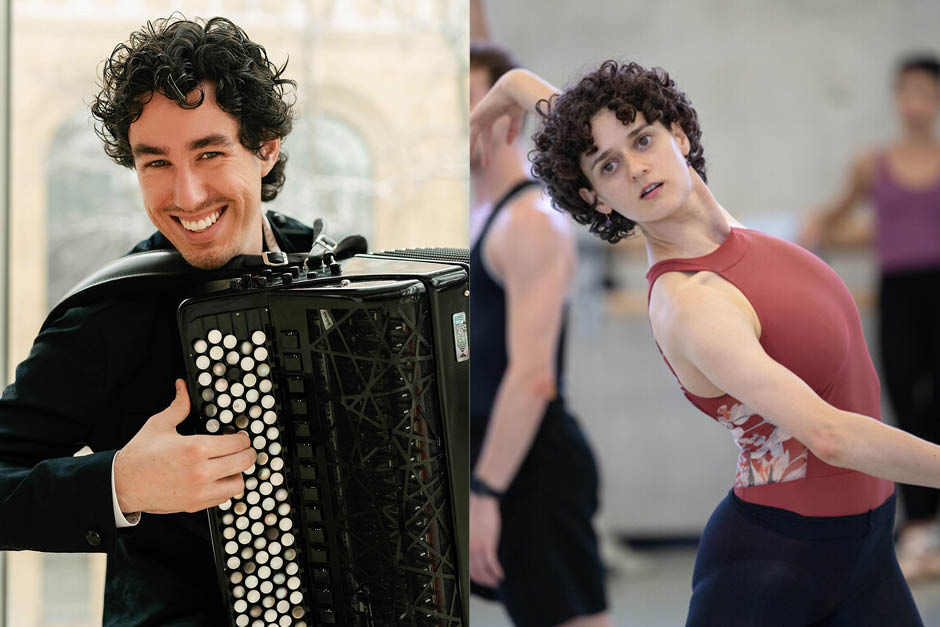
Left: Michael Bridge, photo by Sam Gaetz; Right: Neshama Nashman, photo by Ingo Schaefer
Canadian dancer and choreographer Neshama Nashman brings new works to life on the Jenny Belzberg stage with live music, followed by a performance of Copland’s Appalachian Spring for chamber ensemble.
Program
ERBARME DICH
Yolanda Bruno, violin
Michael Bridge, accordion
Krisztina Szabó, mezzo soprano
Neshama Nashman, choreographer
Anton Tcherny, dancer
JOHANN SEBASTIAN BACH: Erbarme dich, mein Gott from ‘St. Matthew Passion’, BWV 244 (1727)
Michael Bridge, accordion
KHACHATUR AVETISYAN: Tzaghgatz Baleni
AND MY BELOVED
Krisztina Szabó, mezzo soprano
Maeve Palmer, soprano
Katie Kirkpatrick, soprano
Opus13
Neshama Nashman, choreographer
Anton Tcherny, dancer
Irene Yang, dancer
DAVID LANG: just (after song of songs)
Michael Bridge, accordion
PETRO MAKKONEN: Tango-Toccata
MYCELIUM
Opus13
Neshama Nashman, choreographer
Anton Tcherny, dancer
Irene Yang, dancer
SAMUEL BARBER: String Quartet in B minor, Op. 11
Intermission
Jonathan Crow, violin
Hao Zhou, violin
Leslie Ashworth, violin
Valerie Li, violin
Eric Wong, viola
Barry Shiffman, viola
Adrian Fung, cello
Sabina Sandvoss, cello
Jeremy McCoy, bass
Leslie Newman, flute
Todd Palmer, clarinet
Michael Hope, bassoon
Jeanie Chung, piano
AARON COPLAND: Appalachian Spring
Program is subject to change
About the Artists
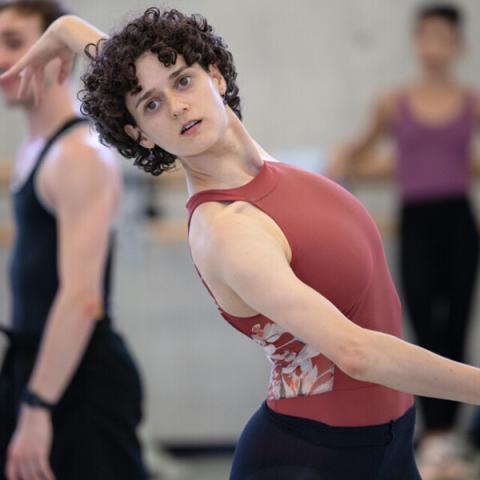
Neshama Nashman
Neshama Nashman is a Canadian choreographer and dance artist based in Düsseldorf, Germany, where she has been a soloist with Ballett am Rhein since 2020. Previously, she was a demi-soloist with the Kraków Opera Ballet in Poland.
As a choreographer, Nashman has gained international recognition for her versatile and passionate approach to the art form. In 2024, Tanz Magazine's Jahrbuch named her an "Interesting Choreographer" for her piece And so am I, created for the Noverre: Young Choreographers project. She is a recipient of two Creation Grants from the Canada Council for the Arts for her Matthäus Passion Project. Her works, including the Kafka-inspired Eine kleine Frau and the pas de deux And my beloved, have been performed at major venues such as the Deutsche Oper am Rhein, the Pina Bausch Center, Mainfranken Theater Wurzburg, tanzhaus nrw, DanceWorks Chicago, Tanzmesse Festival, Düsseldorf, The Stuttgart Ballet, and Toronto’s Royal Conservatory of Music.
Artist supported by:
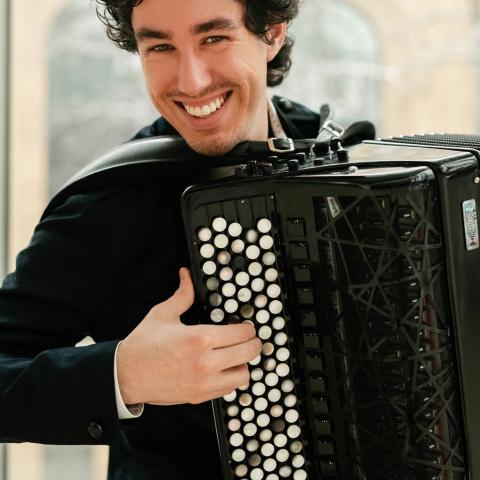
Michael Bridge
Michael Bridge is a 21st-century musical maverick—toppling popular expectations of what it is to be a professional accordionist.
He’s a virtuoso performer—a superstar on both acoustic accordion, and its 21st-century cousin, the digital accordion. He’s won a slew of competitions in Canada and abroad and offers lectures and masterclasses around the world.
He embraces a musical esthetic that is alternatively irreverent, deadly serious, meticulously prepared and completely in-the-moment. He’s at home with jazz, folk and classical music. He’s premiered 53 new works. If pushed, he’ll say he likes Baroque music best because of its unforgiving demand for clarity of intent and execution.
He began playing when he was 5 and growing up in Calgary. His mom bought an accordion at a garage sale for $5. A family friend started teaching him to play by ear. Formal lessons began at 7.
He spent weekends at prairie accordion competitions, playing polkas and learning to dance.
At 15 he attended the World Accordion Championships as a spectator. For the first time he heard classical accordion and fell in love with it. He started all over again, mastering a completely different kind of accordion and a whole new technique.
He was soon offering a hundred community concerts a year. As a soloist with orchestra or string quartet, with his two ensembles, he continues that pace, playing in concert halls all over the world. He received his doctorate in accordion performance from the University of Toronto with Joseph Macerollo (the first Canadian to do so) and is a Rebanks Fellow at the Glenn Gould School.
Bridge (along with his clarinet partner Kornel Wolak) performs on a digital accordion—essentially a computer housed in a conventional accordion case. This extraordinary piece of technological wizardry imitates the sound of just about any instrument you can imagine. He can single-handedly shake the rafters with a convincing “1812 Overture”, canons and bells included. Bridge & Wolak concerts capture the energy and panache of stadium rock with the discipline and finesse of chamber music. Think Bach on steroids.
He’s also mastered the more familiar acoustic accordion, a soulful, highly expressive instrument, essential to the music of Toronto-based Ladom Ensemble. Along with cello, piano and percussion, the Ladom quartet creates a sophisticated blend of everything from traditional Persian melodies, to Bach and Piazzolla, to Radiohead.
Bridge also gives back through an online Music Mentorship Program. After performing hundreds of concerts in schools—usually in the less-than-ideal setting of a packed gymnasium with a tight time limit—Bridge & Wolak determined to build more meaningful relationships with musically inclined teens. With help from composers, tech people and producers, they introduce emerging artists to the wide world of professional music.
When he’s not being a musical renaissance man, you’ll find Bridge salsa dancing, cooking vegan dishes and talking to smart people. He loves to travel and he’s trying to live a more minimal life—abandoning anything that isn’t essential to his life and work.
But what really matters for Michael Bridge is making your world more bearable, beautiful and human—even if only for the length of a concert.
He is grateful for the support of the Canada Council for the Arts, the Sylva Gelber Foundation, and the Women’s Musical Club of Toronto.
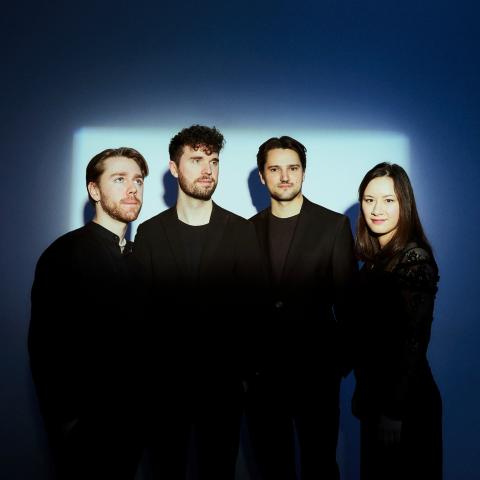
Opus13
"...this was a performance of a profundity and kaleidoscopic colour that would have been astounding from any ensemble, let alone a young one still making itself known."
— Charlotte Gardner, Gramophone
First Prize winners at both the Wigmore Hall International String Quartet Competition and the Bordeaux International String Quartet Competition in the spring of 2025, Opus13 is rapidly building a reputation on the international chamber music scene. Named after Mendelssohn’s youthful and passionate A Minor Quartet, Op. 13 — the first piece they ever played together — the quartet was formed in Oslo in 2014 by four teenagers eager to dive into the world of string quartets. Now based in both Oslo and Stockholm, Opus13 comprises Norwegian violinists Sonoko Miriam Welde and Edvard Erdal, violist Albin Uusijärvi, and cellist Daniel Thorell, both from Sweden.
In addition to performing standard string quartet repertoire by composers such as Mozart, Bartók, and Schubert, Opus13 are passionate ambassadors of Nordic classical and contemporary music, frequently programming works by Grieg, Stenhammar, Tarrodi, Byström, and Fagerlund. They also enjoy genre-crossing collaborations, having performed with Norwegian folk and popular music artists including Gjermund Larsen Trio, Sissel Kyrkjebø, and Sver.
The quartet has appeared at renowned festivals and series including Chamber Music Northwest (Oregon), East Neuk Festival (Scotland), International Chamber Music Festival Utrecht (Netherlands), Yeulmaru and Yonsei Chamber Music Festivals (South Korea), and Rusk Festival (Finland), as well as most of the major chamber festivals in Norway — from Bergen to Stavanger, Rosendal, Trondheim, and Risør.
Opus13 has collaborated with leading musicians such as Janine Jansen, Alisa Weilerstein, Tabea Zimmermann, Olli Mustonen, Julian Bliss, Jonathan Biss, and Anne Sofie von Otter. Their musical development has been shaped by ongoing mentorships with Bjørg Lewis and Berit Cardas of the Vertavo Quartet, and with Tim Frederiksen in Copenhagen. Beginning in 2025, the quartet studies with Prof. Oliver Wille of the Kuss Quartett in Hannover. In 2023, Opus13 received Norway’s prestigious Equinor Classical Music Award, joining a distinguished line of previous recipients including Leif Ove Andsnes, Lise Davidsen, and Vilde Frang.
Opus13 are the founders and artistic directors of Vinterspill på Lillehammer, an annual chamber music festival in Lillehammer, Norway.
The quartet performs on an exceptional set of instruments:
Sonoko Miriam Welde, violin — Antonio Stradivari (1736), on loan from Anders Sveaas’ Charitable Fund
Edvard Erdal, violin — Lorenzo Storioni (1790), on loan from Snefonn AS
Albin Uusijärvi, viola — Christophe Landon (2008)
Daniel Thorell, cello — Giuseppe & Antonio Gagliano (1772), on loan from the Järnåker Foundation
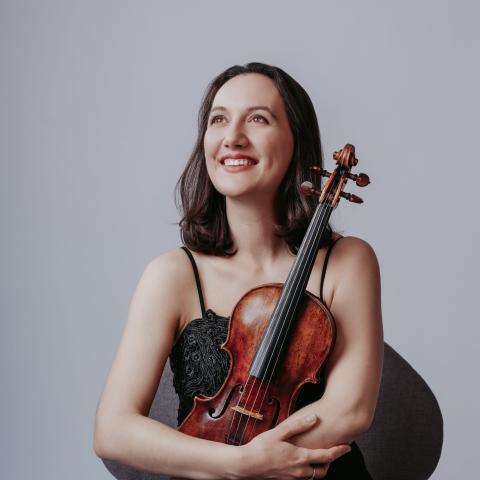
Yolanda Bruno
Yolanda Bruno is an Ottawa-born violinist. She’s won Grand Prizes at the Montreal Symphony Orchestra Competition, the Isabel Overton Bader Violin Competition, and the Canada Council for the Arts’ Virginia Parker Prize—the nation’s highest honour for young musicians. As a soloist, she’s performed with the Montreal Symphony, Toronto Symphony, Orchestra of the Americas, and London Mozart Players.
In 2021, Yolanda founded Music for Your Blues—a performance project offering free-of-charge, personalized, online concerts combining music and poetry. Yolanda has now offered over 70 free performances.
The Wild Swans—Yolanda’s first CD, with pianist Isabelle David—was released in 2019. It features music by 11 women composers, spanning ten centuries, including several world premieres. Yolanda released her second album in 2025—dedicated to the late Jeanne Lamon.
Yolanda’s violin is an exquisite Venetian instrument made by Domenico Montagnana in 1737, on loan from Groupe Canimex. She lives in Toronto with her partner, accordionist Michael Bridge.

Anton Tcherny
Anton Tcherny was born in Toronto, Canada. He began his ballet training in 2015 at Canada’s National Ballet School in Toronto. In 2022 he went to Monte Carlo to continue his education at the Academie Princesse Grace, from which he graduated in 2023. During the 2023/24 season Anton Tcherny was an apprentice with the Stuttgart Ballet. In the following season he became a member of Stuttgart Ballet’s Corps de ballet.
Artist supported by:
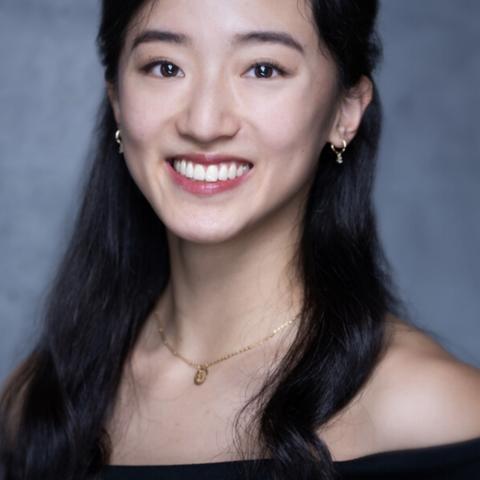
Irene Yang
Irene Yang was born in Toronto (Canada). She began dance training at a private dance studio in Markham, Ontario. In 2011 she attended Elite Danceworx and trained there in all styles of dance. She began her formal classical training in 2014 at the Academy of Ballet and Jazz (School of Canadian Ballet Theatre). In 2018 she came to Stuttgart to join the John Cranko Schule from which she graduated in 2021.
She successfully took part in several competitions. At the Prix de Lausanne 2018, she was a finalist and won a scholarship to the John Cranko Schule. In the years 2016 to 2018, she reached several first and second places at the regional Semifinals of the Youth America Grand Prix.
In the 2021-22 season Irene Yang was an apprentice with the Stuttgart Ballet, one season later she became a member of the Corps de ballet. At the beginning of the 2024/25 season she was promoted to Demi-Soloist.
Artist supported by:
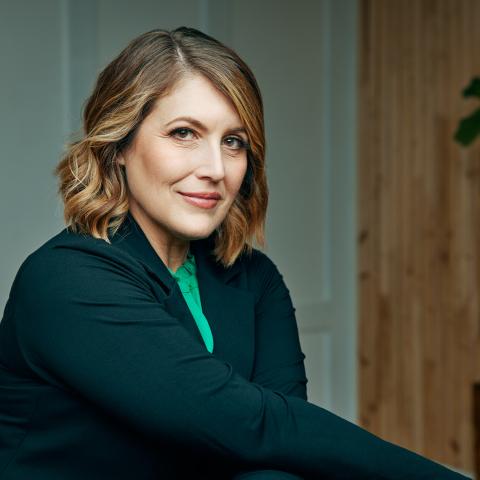
Krisztina Szabó
Lauded for her “supple, pliant” voice and “considerable emotional range” (Opera Canada), Hungarian-Canadian mezzo-soprano Krisztina Szabó is widely recognized for her refined musicianship and compelling stage presence. In the 2025/26 season, she made her Manitoba Opera debut as Marcellina in Le nozze di Figaro, and returned to both Tafelmusik and the Vancouver Symphony Orchestra for Handel’s Messiah. She also premiered two works by composer Jeffrey Ryan: Seven Scenes with the Vancouver Symphony Orchestra and Mother/Land with the Vancouver Bach Choir.
Further recent concert highlights include Handel’s Messiah with the Toronto Symphony Orchestra and Houston Symphony, Mozart’s Mass in C Minor with the Cleveland Orchestra and Orchestre symphonique de Québec, Bach’s St. Matthew Passion with Music of the Baroque, and Mozart’s Requiem with the Vancouver Symphony Orchestra.
A graduate of the Canadian Opera Company Ensemble Studio, Szabó performs regularly across Canada and Europe. She made her debuts at Dutch National Opera and the Royal Opera House in George Benjamin’s Lessons in Love and Violence, later recorded for a Grammy-nominated album. She is Assistant Professor of Voice and Opera at the University of British Columbia and recently appointed Chair of Voice at the Glenn Gould School.
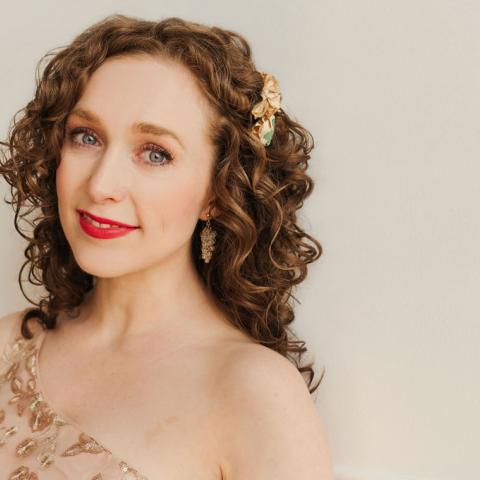
Maeve Palmer
Dora award-winning “triple-threat … coloratura” (Opera Canada) Maeve Palmer has performed with such organizations as the Stratford Symphony Orchestra, Tapestry Opera, Opera Atelier, Off Centre Music Salonga, New Music Concerts, Continuum Contemporary Music, Opera Atelier, the Brampton Rose Orchestra, and on tour with the Eckhardt-Gramatté National Music Competition. A lauréat of the Jim and Charlotte Norcop Prize in Song (UofT) (2021 winner), Maeve is known for her interpretation of contemporary song, and Irish art music. Maeve is also an interpreter of many classic opera roles including Susanna (Le Nozze di Figaro), Zerbinetta (Ariadne auf Naxos), Sandrina (La Finta Giardiniera), Zerlina (Don Giovanni), Queen of the Night (Die Zauberflöte), and Adina (L’Elisir d’Amore).
Recent performances include the title role in The Czardas Princess, with Toronto Operetta Theatre (TOT), soprano soloist in Haydn’s Lord Nelson Mass with the Collingwood Chorale, Adele in Die Fledermaus with the Stratford Symphony Orchestra, Aunt Lydia in The Handmaid’s Tale by Ruders, arr Schlossberg, at the Banff Centre, and Adina in Donizetti’s Elixir of Love, with Highlands Opera.
World premieres include “Vita Brevis” for soprano and chamber ensemble by Norbert Palej, and R.U.R. A Torrent of Light by Nicole Lizée. Maeve’s voice is featured in the Hollywood film The Space Between Us, (2017).
Upcoming performances include Ava in the opera Missing by Brian Current, and the Dew Fairy and Sandman in Pacific Opera Victoria’s Hansel and Gretel.
An alumna of the University of Toronto Opera School, and the Rebanks Family Fellowship and International Performance Residency at the Glenn Gould School, Royal Conservatory of Music,, Maeve holds a Doctor of Musical Arts in Voice Pedagogy and Performance from UofT during which time she resided as a Junior Fellow at Massey College. In her academic career, Dr. Palmer researches vocal function in sean-nós singing, and Irish song traditions within contemporary compositional idioms, and has taught English Song at UofT.
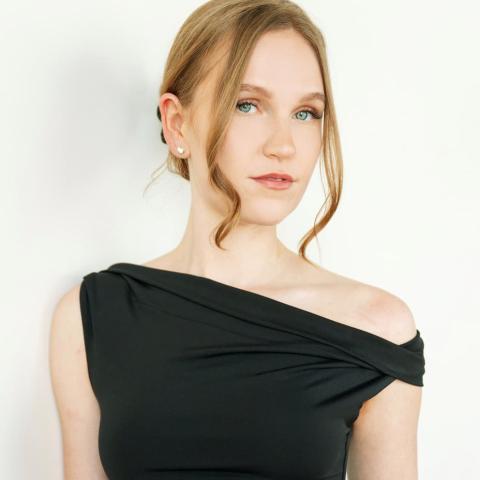
Katie Kirkpatrick
Katherine (Katie) Kirkpatrick is a Canadian soprano from Saskatoon, Saskatchewan, currently based in Toronto. Recognized for her expressive stage presence and affinity for contemporary repertoire, she has recently appeared as Female Chorus in Benjamin Britten’s The Rape of Lucretia, Daria Garbinati in Donizetti’s Viva la Mamma, Miranda in Kaija Saariaho’s The Tempest Songbook, and Janine/Ofwarren in Poul Ruders’ The Handmaid’s Tale as part of Banff Centre for Arts and Creativity’s 2025 Interplay program.
A dedicated performer of art song, Katie was a two-time finalist for the University of Toronto’s Norcop Prize in Song, receiving Second Prize in 2025. This summer, she will travel to Tours, France, to study French mélodie at the Académie Francis Poulenc. Katie holds both a Master of Music in Opera and a Bachelor of Music in Voice Performance from the University of Toronto and will continue her training as a Rebanks Fellow at The Royal Conservatory’s Glenn Gould School during the 2026–27 season.